A kitchen isn’t just where meals get made, it’s where design meets function, and where thoughtful upgrades reveal themselves every time someone reaches for a handle or flips a switch. Luxury kitchen decor doesn’t require gutting the space down to the studs. It’s about intentional choices: the right materials, fixtures that feel substantial in the hand, and finishes that catch light in ways builder-grade components never will. This guide walks through the elements that elevate a kitchen from standard to sophisticated, with practical advice on what to prioritize and where DIY ends and professional work begins.
Table of Contents
ToggleKey Takeaways
- Luxury kitchen decor prioritizes quality materials, attention to detail, and cohesive design—focusing on durable hardware, premium surfaces like quartz or marble, and finishes that age well rather than on price alone.
- Layered lighting with at least three types (ambient, task, and accent) creates visual depth and sophistication; under-cabinet LED strips at 2700–3000K improve functionality, while pendant lights over islands serve as visual anchors.
- Intentional hardware and fixture selections—such as solid brass pulls, ceramic disc faucet cartridges, and PVD-finished components—dramatically elevate the perceived quality and longevity of your kitchen.
- Mixed metal finishes work when limited to two or three types with cohesive sheens (e.g., brushed brass with matte black), while careful cabinet color choices like warm whites with natural wood or bold two-tone schemes create sophistication.
- Soft-close hinges and drawer glides are high-return upgrades costing $5–$10 per pair that subtly reinforce quality with every interaction, while floating shelves and open storage require proper structural support but add visual elegance.
- Luxury kitchen decor succeeds when visible and tactile elements—surfaces you touch daily, finishes that catch light, and proportioned fixtures—are selected thoughtfully, whether through professional installation or well-planned DIY upgrades.
What Defines Luxury Kitchen Decor?
Luxury kitchen decor comes down to three core principles: quality materials, attention to detail, and cohesive design. It’s not about the most expensive option on the shelf, it’s about selecting components that look intentional and perform over time.
Start with the surfaces people touch most: cabinet hardware, faucet handles, and countertop edges. Solid brass pulls feel different than zinc alloy. A single-handle pull-down faucet with ceramic disc valves outlasts compression-valve models. Undermount sinks sit flush with stone counters, eliminating the raised lip that collects grime.
Layering matters. High-end kitchens combine at least three types of lighting (ambient, task, accent), two or more finish metals (typically mixed intentionally, like brushed brass with matte black), and varied textures, polished stone against matte cabinetry, natural wood against metal. These aren’t aesthetic whims: they create visual depth that single-finish spaces lack.
Proportions play a role too. Oversized elements, a 48-inch range instead of 30 inches, 12-inch-deep floating shelves instead of 8-inch, read as more substantial. Cabinet boxes built from ¾-inch plywood with dovetail joinery handle weight and time better than particleboard with stapled corners.
Premium Materials That Elevate Your Kitchen
Material selection separates contractor-grade work from custom-feeling results. For countertops, natural stone (granite, marble, quartzite) and engineered quartz dominate luxury installs. Marble offers veining and history but requires sealing twice a year and etches under acidic liquids. Quartzite provides similar looks with better durability. Quartz (engineered) resists staining and never needs sealing, though it can’t handle hot pans directly, always use trivets.
Backsplashes do more than protect drywall. Slab stone backsplashes that run full-height behind the range create a single uninterrupted surface. Alternatively, handmade ceramic or glass tile in subway, zellige, or geometric patterns add craft. Grout lines matter: ⅛-inch grout joints look tighter and more refined than ¼-inch.
For cabinetry, solid hardwood face frames and doors (maple, oak, walnut) beat veneered MDF in longevity and repairability. Inset doors, where the door sits flush inside the frame rather than overlaying it, require tighter tolerances and cost 15–25% more than overlay, but the reveal lines and shadow gaps look cleaner.
Flooring sets the foundation. Wide-plank engineered hardwood (7+ inches wide, ¾-inch thick) or large-format porcelain tile (12×24-inch or larger) both work. Engineered wood handles temperature swings better than solid in kitchens. Porcelain rated for PEI 4 or 5 withstands foot traffic and dropped utensils without chipping. Many luxury design concepts rely on these same material principles across multiple rooms.
Statement Lighting Fixtures for Upscale Ambiance
Lighting transforms how a kitchen feels at different times of day. Start with task lighting where it counts: under-cabinet LED strips (2700–3000K color temperature, CRI 90+) eliminate shadows on counters. Hardwired puck lights create hot spots: linear strips provide even coverage. Install them toward the front edge of the upper cabinets, not the back wall, so light hits the work surface instead of the backsplash.
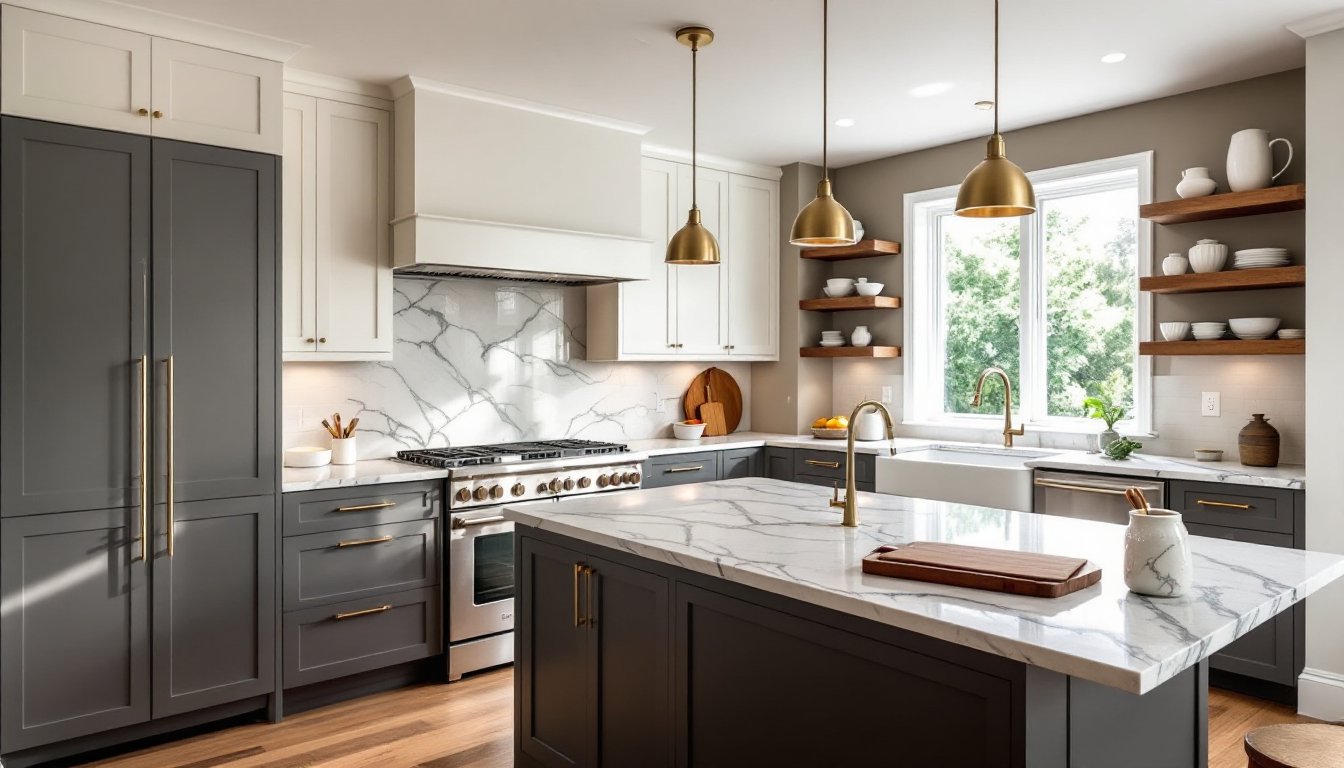
Pendant lights over an island anchor the space visually. For a standard 36-inch-high counter with seating, hang pendants so the bottom sits 30–36 inches above the surface. If the island is 8 feet long, three 10–12-inch-diameter pendants spaced evenly work better than two oversized ones. Materials like hand-blown glass, spun metal, or natural rattan add texture. Wire pendants in series on a single junction box, not individually, cleaner install, one switch.
Recessed cans handle ambient lighting but shouldn’t be the only source. Use 4-inch or 6-inch housings rated IC (insulation contact) if there’s an attic above. Dimmer switches (Lutron, Leviton) for all circuits allow adjustment throughout the day.
For accent lighting, consider in-cabinet LED strips inside glass-front uppers, or toe-kick lighting along cabinet bases. Both require low-voltage wiring (12V or 24V DC) and transformers. These aren’t structural upgrades, most DIYers can handle the install with basic electrical knowledge. Always kill power at the breaker and test with a non-contact voltage tester before touching wires. According to design professionals who analyze high-end spaces, layered lighting consistently appears in top-tier kitchen renovations.
Designer Hardware and Fixtures
Cabinet hardware acts as jewelry for the kitchen. Solid brass or stainless steel handles and knobs outlast zinc alloy, which can pit or tarnish. Bar pulls (sometimes called bin pulls) in 5-inch or 6-inch lengths suit most drawers: knobs work on doors. Mounting holes matter, confirm your cabinet doors are drilled for the backset you’re buying, or plan to redrill and fill old holes with wood filler, sand flush, and touch up with matching finish.
Faucets take daily abuse, so quality counts. Pulldown faucets with magnetic docking keep the spray head secure. Ceramic disc cartridges last 500,000+ cycles versus rubber washers that wear in under 100,000. Finish options include PVD (physical vapor deposition), a process that bonds finish at the molecular level, resisting scratches and corrosion better than electroplating.
Pot fillers, swing-arm faucets mounted above the range, aren’t just for show. They save trips hauling water across the kitchen. Installation requires running a ½-inch cold water line through the wall, which often means opening drywall. Not a beginner project unless you’re comfortable sweating copper or using PEX with compression fittings. Most jurisdictions don’t require permits for fixture replacement, but adding new water lines might.
Appliance hardware can be swapped on many refrigerators and dishwashers. Replacing plastic handles with stainless or brass ones (if compatible) ties appliances into the overall hardware scheme. Check manufacturer specs, some voids warranties if non-OEM parts are used. When selecting fixtures, experienced renovators often reference detailed guidance for upscale properties to ensure choices align with long-term value.
Color Palettes and Finishes for a Sophisticated Look
High-end kitchens avoid the all-white builder trend in favor of layered neutrals or bold, deliberate color. Warm whites (Benjamin Moore White Dove, Sherwin-Williams Alabaster) pair with natural wood tones and brass. Cool grays (Repose Gray, Agreeable Gray) work with stainless and chrome. True black cabinetry (Black Magic, Tricorn Black) creates contrast against white marble or light wood floors.
Two-tone cabinetry, darker lowers, lighter uppers, or a contrasting island, adds dimension. When painting cabinets, surface prep determines results. Degrease with TSP substitute, sand with 150-grit, prime with a bonding primer (BIN shellac-based or oil-based), and finish with two coats of satin or semi-gloss cabinet enamel. Gloss levels above 40 sheen highlight imperfections, below 20 show wear quickly.
Mixed metals no longer break design rules, but keep it to two or three finishes max. Brass cabinet pulls + matte black faucet + brushed nickel pendant lights works. Six different finishes looks unplanned. Match finish sheens loosely, polished brass clashes with oil-rubbed bronze, but brushed brass and brushed nickel coexist.
For walls, skip flat paint in kitchens. Eggshell or satin (30–40 sheen) wipes clean without showing every fingerprint. One gallon of quality paint (Benjamin Moore Regal Select, Sherwin-Williams Emerald) covers roughly 400 square feet. Two coats minimum. Platforms like Remodelista regularly feature kitchens that demonstrate how finish choices create lasting elegance.
Luxury Accessories and Decorative Touches
Accessories tie the design together, but restraint matters. A pot rack (wall-mounted or ceiling-hung) displays cookware and frees cabinet space. Ceiling-mounted racks need to hit joists or use heavy-duty toggle bolts rated for 50+ pounds. Wall-mounted versions require studs or blocking behind drywall.
Open shelving (floating or bracket-mounted) showcases dishes and glassware. Use ¾-inch-thick solid wood or 1½-inch-thick butcher block for shelves longer than 24 inches to prevent sagging. Brackets should hit studs (16 inches on center is standard residential framing). For floating shelves, steel rods embedded into the wall and shelf provide the cleanest look but require precise drilling, rent a template jig if attempting DIY.
Cutting boards in end-grain walnut or maple double as trivets and serving pieces. A utensil crock near the range keeps tools within reach. Textile accents, linen dish towels, a runner on the island, soften hard surfaces but should be functional, not fussy.
Fresh herbs in small pots on a windowsill add life without demanding much care. Avoid fake plants or overly styled vignettes, they read as staged, not lived-in. Many homeowners expanding their design knowledge explore broader ideas for upscale living spaces to maintain consistency across the home.
Organizational inserts (drawer dividers, pull-out spice racks, tray dividers) aren’t visible but improve daily use. Soft-close drawer glides and hinges (Blum, Salice) prevent slamming and add a sense of quality every time a door or drawer moves. Retrofitting costs about $5–$10 per hinge or glide pair, one of the highest-return upgrades for perceived quality.
Conclusion
Luxury kitchen decor isn’t a single big purchase, it’s a series of intentional choices that compound into a space that feels curated and built to last. Focus on the elements touched and seen daily: hardware, lighting, and finishes. Many upgrades sit within DIY reach for someone comfortable with a drill and a paintbrush. Others, plumbing, electrical, structural, benefit from licensed professionals. The difference between a generic kitchen and a standout one often comes down to whether the details were considered or overlooked.